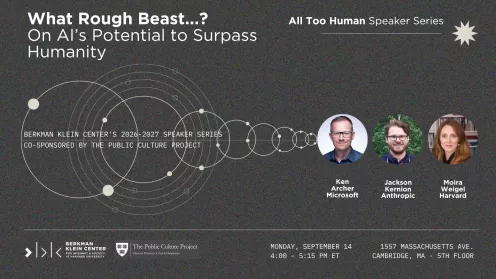


The recent explosion of AI capacity, along with booming prophecies about its limitless potential, arrives at a moment of profound unease. Just over a century ago, in the aftermath of the First World War, W.B. Yeats gave poetic form to a similar anxiety. In The Second Coming, he described an old order unraveling; “the centre cannot hold,” and something new and uncertain is taking shape.
He imagined this new revelation in the form of a sphinx, rising from the desert sand, its gaze “blank and pitiless as the sun,” and ended the poem wondering “what rough beast, its hour come round at last, / Slouches towards Bethlehem to be born?”
Is AI, then, a new Copernican moment? Not because it moves us in the cosmos, but because it unsettles our sense of what makes us central, distinct, and human. What would it actually mean for AI to surpass us? We exercise judgment, form relationships, create culture, make meaning, and act from values and beliefs. As AI becomes more and more capable, which, if any, of these practices remain distinctly ours?
Philosopher and responsible AI leader Ken Archer of Microsoft and Jackson Kernion, who leads the human feedback program at Anthropic, join literary scholar and BKC Faculty Associate Moira Weigel to ask whether AI represents a new Copernican moment: one in which, as in Yeats’ vision of an old order unraveling, humanity’s place at the center is giving way to something new and uncertain. Presented with Harvard’s Public Culture Project, All Too Human: How AI is Shifting the Ways We Make Meaning explores how AI is reshaping our relationships, beliefs, creativity, and sense of what it means to be human.
Speakers
Ken Archer
Ken Archer is a Product Leader in Responsible AI at Microsoft and previously led Responsible AI at Twitch. He is also a doctoral researcher in Philosophy, Cognitive Science and AI at Linköping University, working on a philosophical account of how science and technology emerge from structures of human cognition.
Jackson Kernion
Jackson Kernion is a member of technical staff at Anthropic, where he leads the human feedback program. His work focuses on training and evaluating fuzzy reward signals in reinforcement learning. He co-developed Constitutional AI to automate training harmless language models through self-correction and contributed to early research on red-teaming language models for safety. He studied philosophy of mind as a Harvard undergrad and received his philosophy PhD from the University of California, Berkeley.
Moira Weigel
Moira Weigel is a scholar, writer, and founding editor of Logic magazine. She serves as an Assistant Professor of Comparative Literature at Harvard University and a Faculty Associate at the Berkman Klein Center for Internet and Society. She received her Ph.D. from the joint program in Comparative Literature and Film and Media Studies at Yale University and previously held fellowships at the Harvard Society of Fellows and Data & Society. Her research focuses on the history, theory, and social life of media and communication technologies, with particular emphasis on transnational digital platforms, e-commerce networks between China and the U.S., and the cultural history of critical theory in tech industries.
Pre-Reading
From Ken Archer: The Intelligence We Forgot
From Jackson Kernion: Anthropic's report on recursive self-improvement
You might also like
- communityJournalism in the Age of AI